Reverse logistics is one of the most operationally complex and financially consequential functions in modern retail, and for most enterprise retailers, it is still managed as an afterthought.
According to the National Retail Federation, U.S. consumers were projected to return nearly $850 billion in merchandise in 2025, representing approximately 17% of total retail sales. Behind every one of those returns is a chain of decisions (routing, inspection, grading, refurbishment, resale, or disposal) that either recovers value or destroys it. The difference between the two is how deliberately that chain is managed.
This guide covers what reverse logistics is, why it breaks down at scale, the metrics that actually matter, how leading retailers are modernizing their approach, and what technology makes the difference.
What is reverse logistics?
Reverse logistics is the process of moving products from the end customer back through the supply chain, and managing what happens to each item along the way.
It encompasses every step after a customer initiates a return: transportation back to a facility, receiving and sorting, inspection and grading, the disposition decision (restock, refurbish, resell, or liquidate), and the execution of that decision across downstream channels. In some categories, it also includes end-of-life processing, recycling, and responsible disposal.
Unlike forward logistics, which is optimized for speed, volume, and predictability in one direction, reverse logistics must handle variability in product condition, return reason, channel of origin, category, and recovery potential. Every returned item is different. That variability is what makes it hard.
Reverse logistics is not the same as returns management. Returns management is the customer-facing process: accepting a return request, issuing a label, communicating status, and processing the refund. Reverse logistics is the operational process that follows: moving the product, making the disposition decision, and determining how much value is recovered. Returns management triggers the process. Reverse logistics determines the financial outcome.
For enterprise retailers managing millions of returns annually, that distinction is significant. A well-run returns portal with poor reverse logistics still loses margin on every item. A strong reverse logistics operation compounds value recovery across every return, every category, every channel.

Why reverse logistics breaks down at scale
Most retail supply chains were designed to move product forward efficiently. The reverse flow was added later, bolted onto systems, processes, and infrastructure that were never built for it. The result is a set of structural problems that worsen as volume grows.
Fragmented systems with no shared data layer
The typical enterprise retailer manages returns across disconnected ERP, WMS, OMS, and carrier systems that do not share data in real time. Different stages of the return journey may be handled by different partners (a 3PL for transportation, a separate facility for processing, another for refurbishment), with no unified data layer connecting them.
The consequence: no single source of truth for what is coming back, where it is, what condition it is in, or what it is worth. Inventory records drift from reality. Forecasting becomes unreliable. Recovery decisions are made on incomplete information.
Manual processes that cannot scale with volume
Return volumes are not uniform. Holiday and peak-season surges can drive return volumes 15–25% above baseline within weeks. Facilities staffed for average volume struggle with peak demand. Manual inspection, grading, and routing workflows, common at most retailers, cannot flex fast enough.
The cost is not just labor. Every day a returned item sits unprocessed loses resale value. In fashion and apparel, where trend cycles are short, that value erosion is rapid. In electronics, it compounds with device depreciation. Speed through the reverse cycle is directly correlated with recovery rate.
Disposition decisions made without data
The single most consequential decision in reverse logistics, what to do with each item, is often made manually, inconsistently, and too slowly. Without real-time data on item condition, current resale demand, channel pricing, and refurbishment cost, disposition defaults to the easiest path rather than the most profitable one.
Items that could be refurbished and resold are liquidated. Items that could be restocked are sent to secondary markets. The margin difference between an optimized disposition decision and a default one can be 30–50% of the item's recovered value.
Channel proliferation with inconsistent return rules
Omnichannel retail means returns arrive from ecommerce, in-store, and marketplace channels, each with different policies, timelines, and data structures. A customer who purchased on Amazon operates under Amazon's return rules. A direct website purchase follows a different policy. An in-store return follows a third. Consolidating those flows into a single, intelligent reverse logistics operation requires both technology and operational discipline that most retailers have not built.
The sustainability visibility gap
Consumers increasingly expect retailers to demonstrate what happens to returned products, not just claim responsible outcomes. ReturnPro's 2026 Consumer Sustainability Proof Gap report found that 81% of consumers want retailers to disclose what happens to returned products, yet 77% have never seen that disclosure. Even when sustainable reverse logistics practices exist, the lack of customer-facing visibility limits their ability to build trust.
The Reverse Logistics Maturity Model
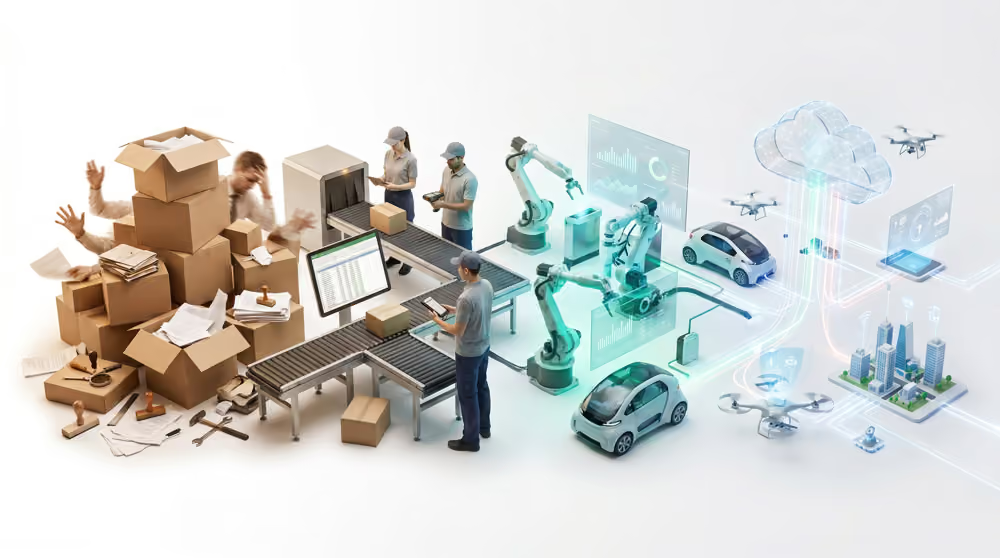
Where does your reverse logistics operation sit today? Most enterprise retailers fall into one of four stages. Each stage has a distinct performance profile, operational signature, and set of strategic priorities.
Stage 1: Reactive
Signature: Returns processed manually, ad hoc, without standardized workflows. Visibility limited to transaction records. Disposition decisions made by individual staff. Recovery rates low. Customer experience inconsistent.
Typical performance: Cost-per-return high relative to industry peers. Recovery rate below 40% of item value. Significant idle time between return initiation and disposition.
Priority: Establish baseline process consistency and data capture before optimizing anything else.
Stage 2: Structured
Signature: Standardized intake and sorting workflows. Basic disposition rules established by category. Returns data captured in WMS or OMS, but not unified across channels. 3PL partnerships in place for transportation.
Typical performance: Cost-per-return declining. Recovery rate 40–55%. Processing speed improving but still manual at inspection and grading stages. No cross-channel visibility.
Priority: Connect data across systems. Automate inspection and grading rules for highest-volume categories. Establish cross-channel return tracking.
Stage 3: Integrated
Signature: Returns data unified across channels and systems. Automated disposition logic applied at item level. Recommerce channels connected for eligible items. Sustainability metrics tracked and reported. Cross-functional alignment between Supply Chain, Finance, and CX.
Typical performance: Cost-per-return at or below industry benchmark. Recovery rate 55–70%. Processing time reduced significantly. Inventory accuracy improved. Fraud detection embedded.
Priority: Scale recommerce programs. Improve real-time resale pricing intelligence. Connect returns data to forward supply chain planning.
Stage 4: Optimized
Signature: AI-driven routing evaluates each returned item in real time against condition, demand, channel pricing, and refurbishment cost. Full lifecycle visibility from return initiation through resale. Returns data feeds forward planning. ESG outcomes measured and reported with audit-ready data. Customer-facing transparency in return outcomes.
Typical performance: Cost-per-return at best-in-class levels. Recovery rate above 70%. Resale velocity optimized by category. Returns function as a measurable margin contributor, not a cost center.
Priority: Continuous optimization of routing logic. Expansion of recommerce to new categories. ESG reporting integration. Closing the sustainability visibility gap with customer-facing disclosure.
Most enterprise retailers we work with enter at Stage 2 or early Stage 3. The gap between Stage 2 and Stage 4 is not primarily a technology gap; it is a data and process discipline gap. Technology accelerates the journey; the foundation has to be built first.
The key metrics that actually matter
Most retailers track cost-per-return as their primary reverse logistics KPI. That is necessary but insufficient. A low cost-per-return achieved by defaulting everything to liquidation is not performance; it is a different kind of margin loss. These are the metrics that together give a complete picture of reverse logistics performance.
Cost-per-return (CPR)
The total operational cost of processing a single return, including transportation, labor, inspection, disposition, and handling. Industry benchmarks vary significantly by category and channel, but enterprise retailers operating at Stage 3 or above typically target CPR reduction of 15–30% over a two-year optimization cycle.
What to watch: CPR declining while recovery rate also declining is a warning sign; it likely means you are routing more items to lower-cost but lower-value channels.
Recovery rate
The percentage of original item value recovered through the return disposition, whether through restock, resale, refurbishment, or secondary market. This is the most direct measure of how much margin the reverse logistics operation preserves or loses.
ReturnPro's 2026 data shows that only 50% of returned products are resold or refurbished across the industry. Retailers operating optimized reverse logistics programs consistently outperform that benchmark by 15–25 percentage points.
What to watch: Recovery rate by category, not just in aggregate. Electronics, apparel, and home goods have very different recovery profiles and require different optimization strategies.
Processing velocity (days to disposition)
The time between a return being received at a facility and a disposition decision being made and executed. Every day of idle inventory is a day of value erosion, particularly in fashion, seasonal goods, and electronics.
What to watch: Velocity during peak periods. If processing time doubles in Q1 (post-holiday), you have a capacity and workflow problem that is costing you in every subsequent resale season.
Resale velocity
How quickly items that have been routed to recommerce or secondary channels are actually sold. High resale velocity compounds recovery rate: an item recovered at 60% of original value but sold within 14 days is worth more than one recovered at 65% but sitting in a recommerce channel for 90 days.
What to watch: Resale velocity by category and by channel. Amazon marketplace, branded recommerce programs, and wholesale liquidation have very different velocity profiles.
Return fraud rate
The percentage of returns that involve fraud or policy abuse: wardrobing, device switching, refund manipulation, or systematic policy exploitation. ReturnPro's data shows that approximately 9% of all returns are classified as fraud, reaching 13% in some consumer electronics categories.
What to watch: Fraud rate by channel. Marketplace channels typically show higher fraud rates than direct channels. Cross-channel fraud, where a customer exploits policies across multiple channels simultaneously, is invisible without unified customer identity data.
ESG / circularity metrics
For enterprise retailers with ESG reporting obligations, reverse logistics is one of the most measurable sources of sustainability data. Key metrics include: units diverted from landfill, carbon impact of return transportation, percentage of returns given a second life, and waste reduction from refurbishment programs.
ReturnPro's operations have spared more than 100 million pounds from landfill across processed returns. That figure represents a measurable, auditable ESG outcome: the type of proof that both regulators and consumers increasingly require.

How leading retailers are transforming reverse logistics
The gap between Stage 2 and Stage 4 performance is not closed by a single technology decision. It requires a set of connected operational changes that build on each other.
Unifying data across the return lifecycle
The foundation of every reverse logistics improvement is a unified data layer that connects return initiation, transportation, receiving, inspection, disposition, and resale into a single view. Without it, every subsequent optimization is constrained by information gaps.
Leading retailers are building this through API-connected platforms that pull data from ERP, WMS, OMS, and carrier systems into a single operational layer, not replacing existing systems but connecting them. The goal is one source of truth for what is coming back, where it is, what condition it is in, and what it is worth.
Automating disposition logic at the item level
Manual disposition decisions are the single largest source of value leakage in most reverse logistics operations. Leading retailers are replacing manual review with rule-based and AI-driven disposition logic that evaluates each item against:
- Current condition (from inspection data)
- Category and item characteristics
- Current resale demand and pricing by channel
- Refurbishment cost and margin after refurbishment Transportation cost to reach the optimal channel
- Fraud signals
The output is a routing decision made in real time (restock, refurbish, recommerce, liquidate, or dispose) without human review for the majority of items. High-value or complex items escalate for manual review. The rest move automatically.
Connecting recommerce channels for higher recovery
Liquidation has historically been the default for items that cannot be directly restocked. Leading retailers are replacing that default with tiered recommerce pathways (branded resale programs, open-box channels, certified refurbishment, and secondary market platforms) that recover significantly more value per item than wholesale liquidation.
ReturnPro's 2026 consumer research found that 82% of consumers are open to purchasing open-box items, and 61% have already purchased refurbished or open-box products. Consumer demand for recommerce is not the constraint. The constraint is retailers' operational capacity to route items there efficiently and at scale.
Embedding fraud detection in the return flow
Fraud detection cannot be a post-hoc audit function. By the time a fraudulent return is identified after the fact, the refund has been issued and the item has entered the processing flow. Leading retailers are embedding behavioral analytics, device verification for electronics, and cross-channel identity data into the return authorization process, detecting fraud before the refund is issued, not after.
Making sustainability outcomes visible
Operational sustainability progress that consumers cannot see does not build trust. Leading retailers are connecting reverse logistics data (units refurbished, pounds diverted from landfill, resale rates by category) to customer-facing communications across product pages, returns portals, and post-purchase emails.
This is not a marketing exercise. ReturnPro's 2026 research found that 60% of consumers say trust increases with disclosure of return outcomes. Visibility is the mechanism by which operational sustainability investments translate into customer loyalty and purchase behavior.
What technology enables optimized reverse logistics
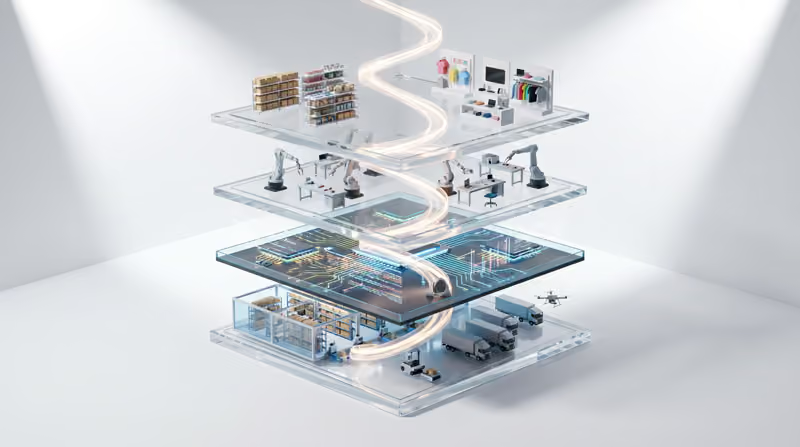
Technology does not fix a broken reverse logistics process. But it does enable a well-designed process to scale in ways that manual operations cannot. These are the capability layers that matter.
Returns management SaaS
The software layer that manages return initiation, authorization, routing logic, policy enforcement, and fraud controls. It connects the customer-facing return experience to the operational processing flow. Key requirements for enterprise retailers: cross-channel support, ERP/WMS/OMS integration, configurable policy rules, and real-time analytics.
Physical reverse logistics infrastructure
Dedicated return processing centers with the capacity, specialization, and geographic distribution to handle high-volume, high-variability reverse flow efficiently. ReturnPro operates dedicated reverse logistics centers across the United States, Canada, Mexico, and China, processing more than 45 million units annually across 250+ categories. Physical infrastructure is often the constraint that technology cannot substitute for; you cannot route items to a facility that does not exist.
Value-add services for recovery maximization
Inspection, grading, cleaning, repair, refurbishment, repackaging, and data wiping services that increase an item's recovery value before it reaches a downstream channel. The margin between a liquidated item and a refurbished item resold through an open-box channel is often 3–5x. Value-add services bridge that gap.
ReCommerce channel integration
Connections to the resale channels (branded recommerce platforms, Amazon Warehouse Deals, eBay, secondary wholesale) that provide the demand side of recovered inventory. Without channel integration, recovered items pile up in facilities waiting for buyers. With it, routing and pricing decisions can be made against live demand data.
Certifications that protect your brand
For electronics and high-value goods, the certifications your reverse logistics partner holds directly affect your downstream liability. R2v3 (Responsible Recycling) certification ensures responsible processing and downstream vendor management. ISO 14001 demonstrates environmental management compliance. ISO 9001 covers quality management systems. SOC 2 addresses data security for electronics processing involving device data wiping.
How ReturnPro fits
ReturnPro is the only fully integrated returns solution that connects returns management SaaS, dedicated reverse supply chain services, and recommerce under one operational model.
Most retailers today work with multiple vendors: a software provider, a 3PL for transportation, a separate facility for processing, another partner for refurbishment, and a liquidator for what remains. Each handoff is a data gap. Each partner has a different performance incentive. The result is the fragmentation that drives Stage 1 and Stage 2 performance.
ReturnPro eliminates those handoffs by owning the full reverse lifecycle: the software that manages the return from initiation, the physical infrastructure that receives and processes it, the value-add services that maximize recovery, and the recommerce channels that create the demand side. One platform, one operational model, one source of accountability.
ReturnPro has processed more than 22 million items and spared more than 100 million pounds from landfill. Those are not projections; they are operational outcomes from a reverse logistics system that has been built and refined over 15+ years across enterprise retail clients.
See how ReturnPro manages the full reverse lifecycle >
Explore returns management SaaS >
Learn about ReturnPro's ReCommerce services >
Frequently asked questions
What is reverse logistics?
Reverse logistics is the process of moving products from the point of sale or end customer back through the supply chain, encompassing returns collection, transportation, inspection, grading, disposition decision-making, refurbishment, resale, recycling, and disposal. Unlike forward logistics, which moves goods from manufacturer to consumer in a predictable, high-volume flow, reverse logistics must handle variability in product condition, return reason, category, and channel of origin. For enterprise retailers, reverse logistics determines how much of the original product value is recovered after a return, making it a direct driver of margin, inventory accuracy, and sustainability performance.
What is the difference between reverse logistics and returns management?
Returns management is the customer-facing process of accepting, authorizing, and initiating a return, including the returns portal experience, label generation, refund processing, and customer communication. Reverse logistics is the operational process that follows: routing the physical item, inspecting it, making the disposition decision, and moving it to its next destination. Returns management determines the customer experience. Reverse logistics determines the financial outcome. A retailer can have an excellent returns portal and still lose significant margin through poor reverse logistics execution.
How much do retail returns cost retailers?
Roughly $200 billion annually is tied up in the movement, handling, and processing of returned inventory across U.S. retail, according to ReturnPro's 2026 Consumer Sustainability Proof Gap report. That figure represents working capital absorbed by return transportation, processing labor, facility costs, and inventory that sits unprocessed losing resale value. Direct cost-per-return benchmarks vary by category: a consumer electronics return costs significantly more to process than an apparel return, owing to device verification, data wiping, and refurbishment requirements. Retailers at Stage 3 or 4 of reverse logistics maturity typically operate at 15–30% lower cost-per-return than industry average.
What are the biggest challenges in reverse logistics?
The primary challenges are: fragmented data across ERP, WMS, OMS, and carrier systems that prevent unified visibility; channel proliferation creating inconsistent return rules and data structures; manual disposition workflows that cannot scale with peak season volume surges; slow processing velocity that accelerates value erosion in time-sensitive categories; and return fraud, which affects approximately 9% of all returns and reaches 13% in consumer electronics. Each challenge compounds the others: fragmented data makes fraud harder to detect, slow processing makes recovery rate harder to maintain, and inconsistent channel rules make data unification harder to achieve.
What is a reverse logistics maturity model?
A reverse logistics maturity model is a framework for assessing where a retailer's reverse logistics operation sits relative to best-in-class performance, across four stages: Reactive (manual, ad hoc, low recovery), Structured (standardized workflows, basic disposition rules), Integrated (unified data, automated disposition, recommerce connected), and Optimized (AI-driven routing, full lifecycle visibility, ESG metrics measured and disclosed). Most enterprise retailers enter at Stage 2 or early Stage 3. The maturity model is useful both for diagnosing current performance gaps and for sequencing improvement investments: addressing data unification before automation, and automation before recommerce channel expansion.
How do retailers measure reverse logistics performance?
The key metrics are: cost-per-return (total operational cost per processed return), recovery rate (percentage of original item value recovered through disposition), processing velocity (days from receipt to disposition decision), resale velocity (speed of downstream channel sell-through), return fraud rate (percentage of returns classified as fraudulent or abusive), and ESG/circularity metrics (units diverted from landfill, carbon impact, percentage given a second life). Cost-per-return alone is an insufficient measure; a low CPR achieved by defaulting to liquidation represents a different kind of margin loss. Recovery rate and processing velocity together provide a more complete picture of operational performance.
What is the difference between reverse logistics and recommerce?
Reverse logistics is the operational process of managing returned products: receiving, inspecting, routing, and processing them. Recommerce is one of the downstream channels and outcomes within that process: the resale of returned or refurbished goods through secondary markets, open-box programs, or branded resale platforms. Recommerce is how value is extracted from items that cannot be directly restocked. Effective recommerce requires effective reverse logistics as its foundation: items must be inspected, graded, and routed to recommerce channels quickly and accurately for the economics to work. ReturnPro's 2026 research found that 82% of consumers are open to purchasing open-box items, but less than 5% of retailer revenue currently comes from recommerce programs, indicating significant unrealized potential.
How does reverse logistics affect sustainability and ESG reporting?
Reverse logistics is one of the most measurable and material sources of sustainability data for retailers. Key ESG outcomes that originate in the reverse logistics operation include: units diverted from landfill through refurbishment and resale, carbon impact of return transportation networks, percentage of returned products given a second life rather than discarded, and waste reduction from responsible end-of-life processing. For retailers with ESG reporting obligations (including those preparing for CSRD compliance or responding to investor sustainability requirements), reverse logistics data provides the traceable, auditable evidence that sustainability claims require. ReturnPro's 2026 Consumer Sustainability Proof Gap research found that only 65% of retailers currently measure the carbon impact of returns, limiting their ability to substantiate sustainability claims.
How do leading retailers use AI in reverse logistics?
AI is being applied in reverse logistics primarily in three areas: automated disposition routing (evaluating each returned item against real-time condition data, resale demand, and channel pricing to determine the optimal downstream path without manual review), fraud detection (using behavioral analytics and cross-channel identity data to identify fraudulent return patterns before the refund is issued), and demand forecasting for returned inventory (predicting resale channel timing and pricing to maximize recovery velocity). The impact of AI in disposition routing is the most financially material; moving from rules-based to AI-driven routing has been shown to improve recovery rates and reduce processing time significantly for retailers at Stage 3 and above of reverse logistics maturity.