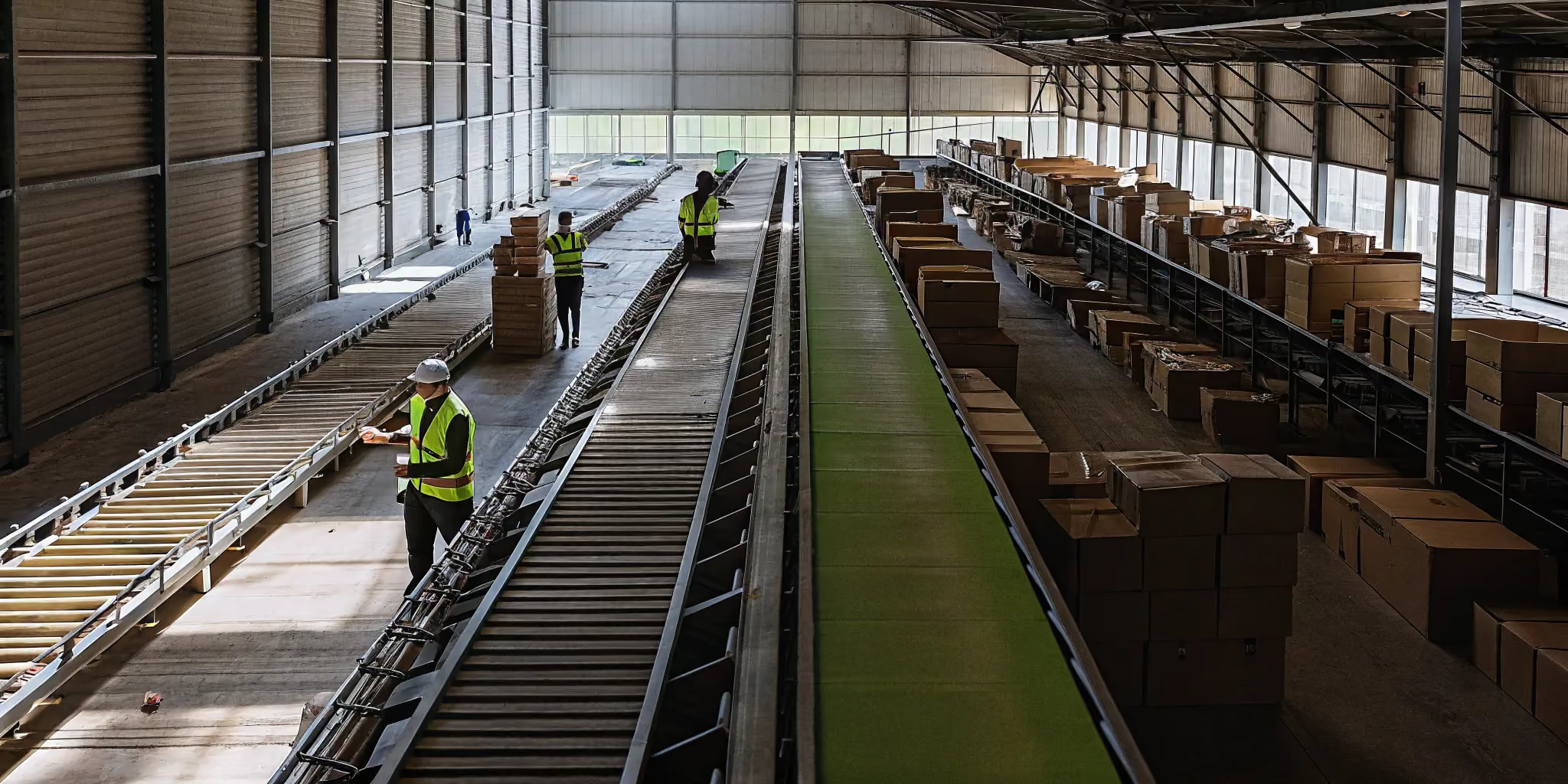
Every retailer knows the feeling: a warehouse bay filled with returned product, no clear path forward, and mounting pressure to do something with it. For mid-market and enterprise retailers processing tens of thousands of returns each month, that "something" used to mean liquidation at pennies on the dollar. Or worse, landfill. In 2026, the retailers recovering the most value from returns are not the ones moving product out fastest. They are the ones routing it smarter.
This guide covers how to build a retail refurbishment program that works for operations processing hundreds of thousands of units annually. It covers intake triage and grading, routing decisions, resale channel selection, and the operational infrastructure that makes it repeatable.
Why retail refurbishment has become a strategic priority
Returns cost US retailers an estimated $890 billion in 2024. A significant share of that inventory is recoverable. The product is functional, the packaging is damaged, or the item was returned for reasons that have nothing to do with defect. Yet most reverse logistics operations are designed around speed of removal, not recovery of value.
The business case for refurbishment has shifted for three reasons.
Margin pressure on primary channels. When front-end margin is compressed, back-end recovery matters more. A retailer that can recover 60 cents on the dollar through graded resale versus 12 cents through bulk liquidation is adding real points of margin back into the business.
Consumer expectations around sustainability. ReturnPro's 2026 Consumer Sustainability Proof Gap report found that 73% of consumers prefer to buy from retailers with documented sustainability programs. Refurbishment is one of the most credible ways to demonstrate circular practice. The gap between consumer expectation and retailer proof is wide. Operational refurbishment programs close it.
Regulatory pressure on returns disposal. Extended producer responsibility legislation is tightening in the EU and beginning to appear in US state policy. Retailers with auditable refurbishment and diversion data are better positioned than those relying on undocumented liquidation.
The core components of a retail refurbishment operation
1. Returns intake and triage
The quality of every downstream decision depends on what happens at intake. Without systematic triage, refurbishment becomes guesswork and the economics fail.
Effective triage requires three things at the item level.
Condition grading. A standardized grading scale (Grade A through Grade D is common; some operations use five tiers) applied consistently across product categories. Grade A typically means fully functional with original packaging. Grade D means parts-only or recycle. The grades in between are where most refurbishment value lives.
Disposition routing. Each condition grade should map to a disposition path: resell as-is, refurbish and regrade, return to vendor, donate, or recycle. This routing table should be defined before the warehouse processes a single item, and it should be category-specific. Electronics grade differently than apparel. Footwear grades differently than small appliances.
Data capture at the unit level. The grading decision needs to be recorded at the item or SKU level, not the batch level. Operations that capture data by pallet or manifest cannot measure their own recovery rates accurately, cannot identify which product categories have the best refurbishment economics, and cannot report sustainability metrics that will hold up to audit.
2. Refurbishment operations
Refurbishment is not a single activity. It is a menu of interventions, and the right intervention depends on what is wrong with the item.
Consumer electronics. Factory reset, inspection, firmware update, repackaging. For defective units: component-level repair or harvest for parts. The economics on electronics refurbishment are strong when handled in volume. Certified refurbished electronics carry a market premium over standard used product.
Apparel and footwear. Retagging, steaming, repackaging for lightly used returns. For items with minor defects: marking as "slight imperfection" and routing to off-price channels. The economics here depend on category and brand positioning. Premium brands often have more to protect and more to recover.
Hard goods and home. Cleaning, repackaging, re-kitting for incomplete sets. For items with cosmetic damage: routing to scratch-and-dent channels, where buyers expect the discount and the margin is still better than liquidation.
Outdoor and sporting goods. Functional inspection, re-stringing, re-assembly, repackaging. Returns in this category often come back in better shape than their appearance suggests. A tent that was opened and repacked still needs inspection and cleaning, not replacement.
The critical variable in each category is unit economics: what does it cost to refurbish versus what does it recover? Operations that measure this by category and by condition grade can make rational decisions about which items to refurbish and which to route elsewhere. Operations without this data are making those decisions by gut.
3. Channel strategy: where refurbished product goes
Refurbishment generates graded, certified product. The question is where to sell it.
Owned resale channels. Some retailers, particularly those with strong brand equity, operate their own certified pre-owned or open-box storefronts. This captures maximum margin but requires dedicated merchandising, customer service, and returns handling for a second time. It works when volume is high enough to justify the infrastructure and when the brand is strong enough to command a premium.
Marketplace resale. Platforms like Direct Liquidation and GoWholesale connect retailers to a buyer network of wholesalers, resellers, and secondary market operators. Selling through a managed resale marketplace requires less infrastructure than an owned channel but gives up some margin in exchange for speed and reach. For most mid-market retailers, this is the right starting point.
Third-party refurbishers and ReCommerce partners. For product categories where refurbishment requires specialized tooling or certification, including certain electronics, medical-adjacent devices, and some appliances, partnering with a certified refurbisher and taking a revenue share or consignment arrangement is often more efficient than building in-house capability.
Off-price and discount channels. For items graded below resalable condition but not yet at parts or recycle stage, off-price channels provide a route that clears inventory faster than remarking for primary channel promotion.
The right channel mix depends on category, volume, and operational capability. Most retailers processing at enterprise volume use more than one, routing Grade A items to owned or marketplace channels and lower grades to off-price or third-party refurbishers.
4. Routing logic and decision infrastructure
The operational failure mode in most retail refurbishment programs is not the refurbishment itself. It is the routing decision that precedes it. Without clear routing logic, returned items sit while people debate disposition, and the window for maximum recovery closes.
Documented and category-specific. A single universal disposition table does not work across categories. Build routing rules at the category level, with clear condition-grade-to-disposition mappings that warehouse staff can apply without escalation for every item.
Integrated with your returns management platform. Manual routing tables live in spreadsheets and degrade. The routing logic should be embedded in the returns management system so that disposition decisions are captured, tracked, and auditable. ReturnPro applies category-level routing rules at intake and records each disposition decision at the unit level, giving operations teams a data-driven view of recovery performance by category, condition grade, and channel.
Reviewed on a defined cycle. Channel economics change. Refurbishment costs change. A routing table built in Q1 may be leaving money on the table by Q3. Build a quarterly review cadence into the program.
5. Sustainability reporting and audit readiness
Refurbishment generates two kinds of value: financial recovery and sustainability data. The sustainability data (units diverted from landfill, pounds of product recovered, resale volume by category) is increasingly required by retail partners, investors, and regulators.
The mistake most retailers make is trying to reconstruct this data after the fact, aggregating it from warehouse reports and resale receipts. That approach produces numbers that do not hold up to audit.
Audit-ready sustainability reporting requires unit-level data captured at intake. If your triage process records disposition at the item or SKU level, the sustainability reporting is a query, not a reconstruction. If it does not, you are building sustainability claims on shaky ground. As ESG reporting requirements tighten, that will matter more, not less.
ReturnPro processed over 45 million units in 2025 and diverted more than 100 million pounds from landfill, with audit-ready data at the unit level for every one of those dispositions. That infrastructure exists because the data architecture was right at intake, not because of downstream reporting effort.
What enterprise scale actually requires
Building a refurbishment program for a pilot, covering a single category or a single distribution center, is a different challenge from running one across multiple categories, multiple DCs, and multiple resale channels.
Consistent grading across facilities. A grading standard that one DC applies consistently is a competitive advantage. A grading standard applied differently across three DCs produces inconsistent channel routing, inconsistent recovery rates, and sustainability data that cannot be consolidated. Training, QA protocols, and system-enforced grading criteria are all part of the solution.
Technology that supports routing complexity. At low volume, routing decisions can be made manually. At high volume, routing logic needs to be embedded in the returns management platform and applied programmatically at intake. The alternative is a routing bottleneck that slows processing and degrades recovery economics.
Vendor and channel relationships at volume. Resale channels have capacity constraints. A retailer processing 500,000 returns a month needs channel partners who can absorb that volume, and a mix of channels so that no single partner becomes a bottleneck. Building those relationships before you need them is easier than building them under volume pressure.
Financial reporting integration. At enterprise scale, recovery from refurbishment and resale needs to flow into financial reporting in a way that is visible to finance teams. Cost-per-return, recovery rate by category, and net recovery value are metrics that CFOs and VP-level operations leaders are tracking quarterly. If those numbers are not available from your returns management system, they are being reconstructed by hand and they are probably wrong.
Getting started: the right first steps
For retailers who have not yet built a systematic refurbishment program, the instinct is often to start with technology. That instinct is usually wrong.
1. Audit your current return flow. Before buying software or building a grading operation, map what actually happens to returned items today. Which categories are going where? What is the disposition split between resale, liquidation, donation, and disposal? What is the current recovery rate? You cannot improve what you have not measured.
2. Define your grading standard. Choose a condition grade scale and write the criteria for each grade, by category. This does not require software. It requires discipline. Get operations, merchandising, and finance in the same room and agree on what Grade B means for electronics versus what Grade B means for apparel.
3. Stand up a triage process before you optimize it. Start with manual triage at one DC and one or two categories. Measure the recovery economics. Refine the routing logic based on what the data shows. Then automate.
4. Choose your first resale channel. Pick one channel to start, not five. Learn the economics, the throughput, and the buyer behavior. Expand from a position of understanding.
5. Build the data capture first. Whatever systems you stand up, make sure item-level disposition data is captured from the start. Retrofitting data capture into an existing operation is expensive and usually incomplete. Getting it right early is not.
The competitive position in 2026
Retailers who operationalize refurbishment well do not just recover more value. They build a structural cost advantage that is difficult for competitors to replicate. The grading expertise, the channel relationships, the routing logic, the data infrastructure: none of these develop quickly, and all of them compound over time.
The retailers who started building this in 2022 and 2023 are now seeing refurbishment recovery rates that make their liquidation-first competitors look like they are leaving significant margin on the table. Because they are.
The window to build this capability is still open in 2026. It will not be open indefinitely.
ReturnPro operates reverse logistics, ReCommerce, and resale infrastructure for enterprise and mid-market retailers across North America. ReturnPro has processed more than 45 million units and diverted more than 100 million pounds from landfill, with clients including Walmart, Sam's Club, Bass Pro Shops, Lenovo, Milwaukee Tool, and Ferguson.