Retail customer experience (CX) leaders have spent enormous energy shaping customer perceptions across brand promise, product quality, delivery speed, and in-store or digital interactions. Personalization, speed, and convenience have reshaped expectations across the front half of the retail journey. Yet some of the most decisive customer judgments are formed later, within the post-purchase customer experience, when expectations aren’t met and a return becomes necessary.
Returns happen when expectations break down. In these moments, customers are not seeking delight; they are seeking reassurance. They want confidence that the brand will resolve disappointment fairly, efficiently, and transparently. How that moment is handled often determines whether the relationship continues or quietly ends.
This is why CX leaders must rethink returns not as a transactional afterthought, but as a strategic trust moment, one shaped by returns visibility and tracking, clear communication, and consistent execution that directly influences loyalty, repurchase behavior, and customer lifetime value.
Why Returns Deserve Strategic Attention Now
Returns are a frequent and predictable customer experience. In U.S. retail, eCommerce return rates routinely range from 20–30% depending on the category, with rates climbing even higher during peak seasons such as holidays and major promotions, according to the National Retail Federation (NRF). This means a significant portion of customers experience a brand most directly through the return process, often more often than through loyalty programs or support initiatives.
Just as importantly, returns shape future behavior. Research from UPS’s Pulse of the Online Shopper (UPS) shows that more than 80% of consumers say a positive return experience makes them more likely to shop with a retailer again, while poor return experiences materially reduce repeat purchases. For CX leaders, returns are not operational noise, they are one of the clearest determinants of long-term trust in the post-purchase customer experience.
The Return Is a Trust Test
During a return, customers are not evaluating internal efficiency metrics. They are asking three simple questions:
• Do I know what’s happening right now?
• Do I know when this will be resolved?
• Can I trust this brand to follow through without effort on my part?
When answers aren’t clear, anxiety rises quickly. This anxiety drives frustration and then contact. Research from Zendesk and Salesforce consistently shows that return-related questions, especially refund status and tracking, are among the top drivers of post-purchase service inquiries. Most of these contacts aren’t complaints; they’re requests for reassurance. The underlying issue isn’t the return itself. It’s the lack of clear, proactive communication during the process.
Why Do Returns Generate So Many Customer Service Calls?
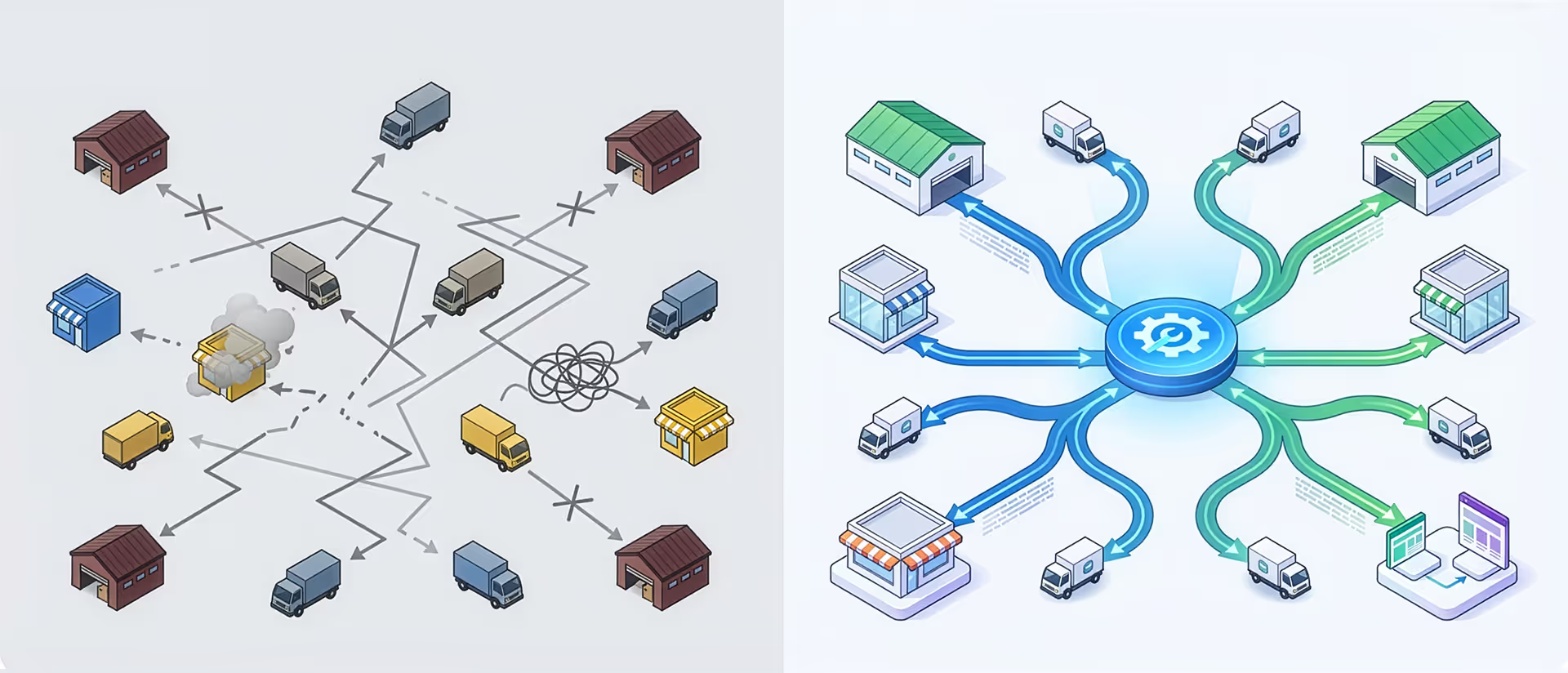
Because most retail systems (OMS, WMS, payments, CRM) were designed to process returns, not to proactively communicate progress to customers. As a result, customers are left to wonder what’s happening behind the scenes.
When customers can’t see progress, they call. Poor visibility becomes a primary driver of rising support volume and refund-related escalations. Reducing return-related service demand doesn’t require more agents. It requires removing uncertainty.
Visibility, Automation, and Consistency Change Customer Behavior
When customers have clear insight into:
- Return initiation
- In-transit status
- Receipt confirmation
- Refund approval and timing
…their behavior changes.
According to Gartner and Forrester CX research, lack of visibility is a leading cause of service escalation, while proactive status updates significantly reduce follow-up inquiries. Retailers that provide end-to-end return tracking consistently report fewer “where is my refund?” contacts and higher post-return satisfaction.
Automation plays a critical role here, not primarily for efficiency, but for reliability. Manual returns processes introduce variations: different agents, different interpretations, different timelines. From the customer’s perspective, inconsistency feels like unreliability.
Automated workflows create confidence by enforcing:
- Immediate confirmation
- Milestone-based updates
- Consistent policy application
- Predictable refund timelines
According to McKinsey’s research on service operations, customers are often more satisfied with consistent, predictable outcomes than with faster but uncertain ones. Reliability builds confidence, and confidence is foundational to loyalty. For experience leaders trying to reduce call center volume from returns, automation is less about efficiency and more about eliminating ambiguity.
Self-Service Strengthens Confidence, Not Distance
Customers increasingly prefer self-service for routine post-purchase actions, provided it delivers real information and clear outcomes. Research from Salesforce’s State of the Connected Customer (Salesforce UK) shows that customers increasingly prefer self-service for routine post-purchase actions, provided those tools deliver real-time information and clear outcomes. A well-designed self-service returns portal allows customers to:
- Initiate returns on their own schedule
- Instantly understand eligibility
- Choose return methods
- Track progress without contacting support
When self-service is transparent and reliable, customers don’t feel pushed away from help, they feel empowered.
Return Policy Optimization Is a CX Responsibility
Return policies often evolve to manage internal risk and cost, while losing sight of the customer’s need for clarity and confidence. Over time, they become longer, more complex, and harder for customers to interpret.
Reports from ReturnPro and PwC (ReturnPro) show that customers value clarity and fairness more than flexibility alone. Policies that are easy to understand and consistently applied preserve trust, even when a return is denied. For CX leaders, return policy optimization means:
- Simplifying language
- Communicating expectations early
- Applying rules consistently across channels
Clarity reduces conflict. Consistency preserves confidence.
Why Returns Influence Loyalty More Than Expected
Customers who trust the return process perceive future purchases as lower risk. Data from UPS and NRF consumer studies shows that customers who experience a smooth return are significantly more likely to repurchase within the following 6–12 months than customers who experience delays, uncertainty, or inconsistent communication, even if the original product met expectations.
The opposite is also true. When return experiences feel opaque or unpredictable, customers rarely complain loudly, they don’t come back. Returns are one of the most common moments where trust erodes quietly and quickly.
Why CX Leaders Must Act Now
Rethinking returns is not about adding complexity or chasing trends. It is about recognizing where trust is most fragile. Customers may forget how fast checkout was or how easy it was to browse inventory. They will remember how confident, or anxious, they felt waiting for a refund.